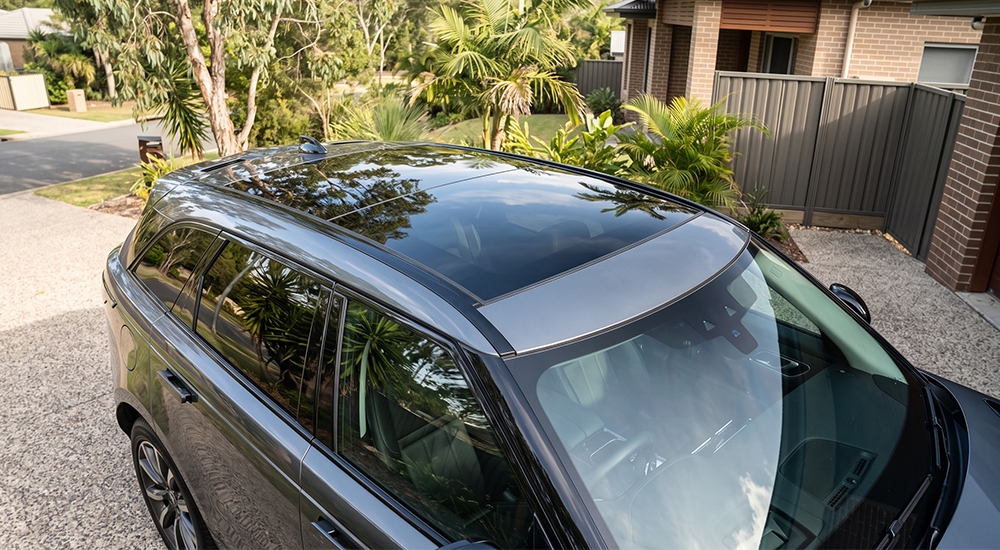
A sunroof looks great in the showroom. Then your first Queensland summer arrives, and the glass over your head turns the cabin into a slow cooker by mid-morning. If you’ve been looking into sunroof tint, the short answer is yes, you can tint a sunroof of any size… from a small tilting panel to a full panoramic glass roof. Here’s what it does, what it won’t do, and how it compares to the clip-in sunshade you’ve probably already looked at.
Why Glass Roofs Get So Hot
Your side windows are mostly upright, so the midday sun hits them at an angle. A sunroof faces straight up, which means it takes the full force of the sun for most of the day. In Brisbane, Ipswich and the Gold Coast, that’s a lot of heat landing on a pane of glass right above your head.
Most factory sunroofs and glass roofs are already tinted, and many block a good share of UV. What they still let through is infrared heat, the part of sunlight you feel on your skin rather than see. That’s why a roof can look dark and still leave the top of your head baking at the traffic lights.
Can You Tint a Sunroof?
Yes. Film goes on the inside of the glass, the same way it does on your side windows, and it works on both opening sunroofs and fixed glass roofs. The film moves with the glass, so a sliding or tilting sunroof still opens and closes as normal.
Standard Sunroofs vs Panoramic Glass Roofs
A standard sunroof is a small panel, so tinting it is a quick addition to a full car tint. Panoramic roofs are a bigger job. On some vehicles, including the Tesla Model 3 and Model Y, the glass runs most of the length of the cabin and there’s no built-in blind to pull across. That leaves heat control at the glass as the only real option short of a clip-in shade. Large curved panels also take more time and skill to fit cleanly, so expect the quote to reflect the size of the glass.
What Sunroof Tint Does for Heat and UV
The film we use on car glass is ceramic. It’s designed to reject infrared heat while staying clear enough that you keep the light and the sky view you paid for. On a car with a large glass roof, the roof is the biggest single source of overhead heat, so it can make one of the most noticeable differences of any window, especially for passengers in the back seat who sit right under the glass. If you want the detail, here’s what ceramic tint actually does in Queensland heat.
Ceramic film also blocks up to 99% of UV rays, which helps protect your seats, dashboard, trim and skin on long drives. We only quote ceramic, and our guide to car window tinting cost explains why the cheaper dyed films aren’t worth it on any glass, let alone a roof.
Sunroof Tint vs a Clip-In Sunshade
Plenty of owners, Tesla drivers in particular, buy a mesh sunshade that clips under the roof. It’s cheap and it does block the sun, but it also blocks the view, which is why most people wanted the glass roof in the first place. And because the shade sits below the glass, the glass itself still heats up and radiates that warmth into the cabin.
| Factor | Sunroof tint | Clip-in sunshade |
| Sky view | Kept | Blocked |
| Where heat is stopped | At the glass | Below the glass |
| Day-to-day effort | None, it’s permanent | Fit, remove and store |
| Upfront cost | Higher | Lower |
Some owners use both on the hottest days, and that’s a reasonable approach. It’s a familiar pattern, though: someone picks up a new car with a gorgeous glass roof in spring, and by their first January the sunshade is in permanently and well, to me, that could just defeat the purpose.
Why Glass Roofs Need an Experienced Installer
Roof glass is often laminated and sometimes coated at the factory, and it’s usually larger and more curved than a side window. The film has to be shaped to the curve, trimmed cleanly around the frame and matched to the glass, because the wrong film on a large roof panel can absorb more heat than the glass is designed to handle. We check your glass before recommending a product, and every car is fitted in our workshop, where a clean, dust-free space is what makes a large panel turn out right.
FAQs: Sunroof and Glass Roof Tinting
Is Sunroof Tint Legal in Queensland?
Yes. Queensland’s tint laws set minimum light levels for the windscreen, the front side windows and the rear windows. Those rules exist so you can see the road and other drivers can see you. A sunroof doesn’t play a part in either. Most cars don’t have a glass roof at all, and nobody expects a solid steel roof to let light through, so there’s no road safety reason to limit how dark a glass roof can be. That’s why the VLT limits don’t extend to sunroofs, and it’s the same in Victoria, where the rules say outright that windows above the driver are exempt.
In practice, the limit on sunroof tint is comfort rather than the law. Go too dark and the cabin can feel gloomy, which defeats the point of a glass roof. That’s why we usually recommend a ceramic film chosen for heat rejection rather than darkness. You keep the light and the view and lose most of the heat. If you’d like a refresher on the rules for every other window, our guide to Queensland window tint laws covers the lot.
Can you tint a Tesla glass roof?
Yes. Tesla glass roofs can be tinted with ceramic film to cut the heat coming through them. Because the panels are large and curved, it’s a job for an experienced installer, and we’ll check your specific model before quoting.
Will tinting my sunroof make the cabin too dark?
No. Ceramic film can be chosen for heat rejection rather than darkness, so the roof stays bright while cutting the heat. We’ll show you the options before anything goes on.
Can you tint just the sunroof?
Yes. You can book the sunroof on its own or add it to a full car tint. Doing it all at once is usually more efficient if the rest of the car needs tinting too.
Will tint stop my sunroof from opening?
No. The film goes on the inside face of the glass and moves with it, so a sliding or tilting sunroof works exactly as it did before.
Sunroof Tint That Keeps the View and Loses the Heat
Sunroof tint is one of the simplest ways to make a glass roof bearable through a Queensland summer. It works on standard sunroofs and full panoramic roofs, keeps the view you bought the car for, and does its job at the glass rather than under it. Choose ceramic film, get it fitted properly, and the roof goes back to being a feature rather than a heat lamp.
We tint cars at our Booval workshop for drivers across Ipswich, Brisbane and the Gold Coast, and since you’ve found us, you’re already in the right place (shameless, but true). Have a look at our car window tinting options, or call 1300 Get Tint (or 0400 700 154) for a free consultation.